Introduction
Eugen Varzić is a striking painter with a distinctive artistic sensibility that has long set him apart from the mainstream of Croatian painting. He draws on the heterogeneous world of 20th-century American painting, as well as on Spanish contemporary figurative traditions, shaped by his participation in the Catalan Figurativas and by his friendships and collaborations with major figures on the Spanish art scene, including Antonio López García and Eloy Morales. Through these encounters, he absorbed the latest artistic trends and techniques, setting his work apart from familiar conventions of Croatia’s relatively insular art scene. It bears repeating that Eugen Varzić has subconsciously remained a faithful follower of Andrew Wyeth, arguably his greatest follower on this side of the Atlantic. The series shown two years ago in Motovun was painted entirely in the style of mystical (magical) realism, which is, by definition the term for a naturalistic style of painting in which the artist strives to depict the object as faithfully as possible, illuminating it with such effects that it takes on the appearance of the unreal and the visionary. Mystical realism emerges consistently in periods of social crisis, as a response to the meaninglessness of the moment, having developed in the second decade of the 20th century under the influence of metaphysical painting. This artistic tendency, articulated in distinct ways across different milieux, manifested in various ways: in Italy through the Valori Plastici movement (Giorgio De Chirico, Giorgio Morandi), and in Germany through the New Objectivity – Neue Sachlichkeit (Georg Schrimpf, Alexander Kanoldt, Carlo Mense). Around 1930, mystical realism appeared autonomously in America, most notably in the paintings of Andrew Wyeth and Peter Blume. In Croatia, Marino Tartaglia and Vladimir Varlaj painted in this manner. Mystical realism is, moreover, a highly sophisticated form of painting, executed with exceptional technical skill by an intellectual painter who engages critically with the world around him, rather than by a painter concerned primarily with craftsmanship. Eugen recognises that art carries within it a reflection of perfection, to which a noble soul aspires; it cannot, therefore, stand in conflict with morality provided it contains that reflection. Art offers perfect symbols of virtue and vice, as well as various pleasures, sentimentality among them. Feelings accompany our perception, functioning as a bridge between instinctive and psychic life. This new series of mystical realism presents the contrast between the rational and the supernatural as a prosaic reality, constructing an entirely new iconography within a domestic frame of reference, or, more precisely – within the sphere of the Mediterranean and international scene – since it must be stressed once more that Varzić is set apart from Croatian artistic movements, oriented instead towards foreign artistic circles and centres, where he enjoys an enviable reputation. He collaborates with the Artelibere Gallery (Galería Artelibere), which represents him and shows his work at exhibitions from Spain to America. He has shown his work twice as an invited artist at Algo más que realismo in Zaragoza – an exhibition that brings together the world’s foremost painters of realism and hyperrealism. As the only Croatian representative in the Mod Portrait project, he exhibits at MEAM (Museo Europeo de Arte Moderno) in Barcelona alongside the world’s leading portrait painters. He has furthermore established collaborations via a range of platforms, including IBEX Insiders and Chicago-based PoetsArtists, through which, in 2023, he participated in the group exhibition Painting the Figure Now at the Wausau Museum of Contemporary Art in Wisconsin, in the United States. He has also been featured by Australia’s Sydney-based Beautiful Bizarre Magazine, itself among the world’s leading magazines promoting contemporary art. He has been a finalist for the BB Artist Award on two occasions, and is additionally a finalist in the FIKVA competition, dedicated to figurative artistic expression. Indeed, it is difficult even to enumerate the artist’s international engagements in full. Taken together, all of these international artistic contacts have secured him a lasting artistic autonomy and objectivity.
Eugen Varzić is characterised, first and foremost, by a high degree of artistic excellence, a masterly command of painting techniques, and continual, persistent refinement – and, most crucially for a bravura technique, in addition to daily, sustained effort – long hours spent seated before the easel, reflecting on how, and in what direction, to proceed further along the paths of artistic exploration. The following lines from the poem Gorući grm (The Burning Bush), by the great figure of Croatian poetry, Viktor Vida, could aptly be applied to him: “(…) My God, / You share the selfsame love with the beggar / And the lord, whose fingers, set with precious stones / Rest upon velvet. / Over the clouds and above the river you reign, / Eclipsing the armoured knight — / Your fire ripens the fruit, / And sweetens the labouring dream. (…)”. Eugen carries within him a cosmogony of memories, wartime experiences, life’s struggles, and the family that is his harbour and his solace. His life is his art. He finds his models among acquaintances and fellow citizens, in the manner of Caravaggio, fashioning them into new vera icons of the harrowing spiritual present. He breathes into his models a new spirit, using their figures to probe the fears and crises of contemporary Croatia and of the world. The maestro from Kukci in Istria and from flat, native Slavonia is a frequent visitor to the great museums and galleries. In the halls of the Accademia in Venice he assimilates the techniques of Veronese and Tintoretto, together with the brightness of the Macchiaioli, while in the halls of the Louvre his eye is drawn to Rembrandt. This Dutch painter, who in his atmospheric and sombre portraits subjected his fellow citizens to a uniquely penetrating scrutiny, prompted Eugen to probe deep into the inner worlds of his own models, so that they might become a kind of Museo de la Imaginación of all the horrors through which contemporary Croatian society is passing. As a truly socially engaged painter, Eugen critically examines society; far more so than many a loudly-hyped name on the Croatian art scene, for it was with a rifle that he helped create the state in which we now live, without securing any benefit from it, either for himself or for his family. He pays a heavy price for his unambiguous social engagement and political stance, in the form of the isolation of the intellectual who thinks independently and speaks out openly about the afflictions of people transformed into spiritual monstrosities, afflictions that have found their reflection in the motifs of the body of work of this towering figure on the contemporary Croatian art scene. Eugen Varzić is difficult to fit within the confines of any particular artistic movement; he might most simply be described as a neo-figurativist of mystical realism. It should again be emphasised that his painting is primarily engaged – it examines the present day and the social trends of contemporary Croatian society. On this occasion, he has distilled the recapitulation of several phases of his artistic journey into miniature formats, comprising 101 paintings. In numerology, this is the angel number associated with self-knowledge, the questioning of the world, and one’s own spiritual growth. This is painting of the human face, a considerable challenge for any artist. Every person carries their own story, life, and burden. The Italian Mannerist poet Giambattista Marino (1569–1625), in his poem Human Life, expressed the essence of human fate with the greatest concision, from the cradle to the heavy stone of the grave. The artist’s role is to transform the moment of being into an eternal present, continually striving to refine his artistic techniques, so that the present human moment may be preserved, in classical formats and techniques, for some other time. The painter Varzić has ventured to impose a particular rhythm upon his figurative oeuvre, connecting the worlds of human imagination with the memories retained through portraits.
On Miniature Painting
Miniature painting, a world in miniature, is a kind of hortus conclusus of life’s memories, recollections, and yearnings, in which artists take refuge, fleeing from time, that thief of life – Chronos – who seizes and tears at our vital energy amid the bleak everyday reality of the wars in which we live. The barbarians crossed the Danube long ago; the last towers along the limes have fallen, and we go on living in our provincial cities – waiting for the barbarians, unaware that we have long been coexisting with them, and that our civilisation is disappearing altogether. The Europe in which we were born, in which we came of age, and in which we fought to secure our own state, a state we then cheaply relinquished, together with the civilisational values for which our ancestors fought and bled for centuries – that Europe is nothing more than a pipe dream; it does not exist. In such times, what remains to all of us is flight into solitude, flight into surreality, much like the late antique Byzantines, who built basilicas filled with golden mosaics, constructing an imagination of the otherworldly amid the uncertainty of the final days of the Earthly Empire. The art of the miniature – small-scale painting, has in Croatian art history remained canonised in the oeuvre of Julije Klović (1498–1578), a towering figure of this artistic genre and the greatest miniaturist of Mannerism in general, whom El Greco immortalised together with Michelangelo, Raphael, and Titian in his 1570 painting Christ Driving the Traders from the Temple, depicted holding the Officium Virginis Farnese, regarded as the pinnacle of Mannerist miniature painting of all time. The miniaturist Julije Klović began his artistic career at the court of the Croatian-Hungarian king Louis II Jagiellon, in the same location where the Dubrovnik-born diplomat of note, Feliks Petančić (c. 1455 – after 1517), had served as head of the Buda school of miniature painting.
Dubrovnik is a city of astonishing hidden beauties, where the shelves of its libraries still preserve some of the greatest treasures of the written word from Croatia’s earliest centuries, including 11th-century miniatures – ranging from the complete Biblia Atlantica of the Dubrovnik White Friars to the Gothic miniatures housed in the Franciscan treasuries. There are, in addition, illuminated matriculation books belonging to numerous confraternities, such as the Confraternity of St Joseph and the Zbor Popovski. The miniature of St Blaise in the city statute, attributed to the Dubrovnik painter Matej Junčić (? – 1454), testifies to the significance of miniature painting in the everyday life of late medieval and early modern Dubrovnik, an art form encompassing prayer books, portraits, and book design alike, thereby confirming art’s need to enter the most intimate sphere of human life, and become part of the things people cherish the most. Dubrovnik kept its tradition of miniature painting alive even into the Baroque period, by which point this art form had already become entirely anachronistic, given that the spirit of the age had shifted since the time of Juraj Dragišić (1445–1520) and his portrait in the incunabulum On the Nature of Angels (De natura angelica). Miniature painting has its own rules and its own set of values. The Split-based Franciscan Bone Razmilović (1626–1678), for example, through his sincere artistic credo set down on the pages of ecclesiastical books, gave shape to a world of insects and flowers marked by the particular beauty of a simple and honest perception of the world, in contrast to the great Dubrovnik intellectual, historian, miniaturist, and father of Croatian collage, Fra Serafin Marija Crijević (1678–1759). Crijević understood the miniature as an ancilla, a handmaiden, of history and scholarship. During the late Baroque, Empire and Biedermeier periods, building upon the Renaissance and Mannerist tradition, miniature painting once again returned to the portrait, capturing the likenesses of numerous personalities, sometimes reduced to the profile of a paper silhouette. The miniature portrait is perhaps the most intimate of forms, hidden away in medallions and portable cases that conceal cherished likenesses. In time, this tradition would evolve into the sumptuous presentation of portrait daguerreotypes, treasured as objects of bourgeois private life. Just as the haiku is a miniature form of poetry, so these little paintings – miniatures in miniature – testify to great things, emotions and flights of imagination, distilling into a small format the artist’s visions born on the grand scale of the canvas.
Eugen’s Miniature Painting
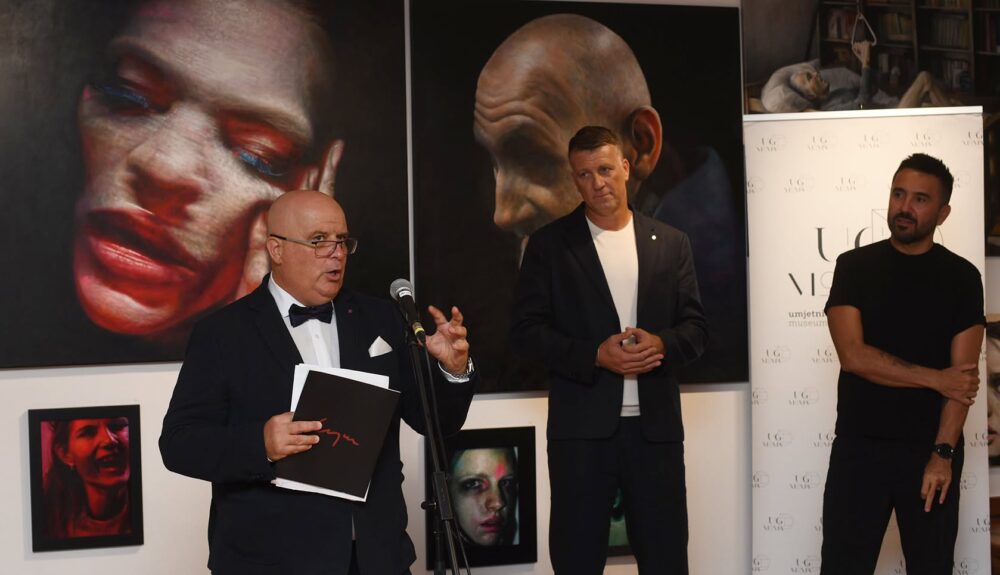
The Dubrovnik exhibition presents a cross-section of the artist’s phases and stylistic variations, which began with a curious adventure – a moment of heavenly inspiration while painting Nona, his wife’s grandmother. Together with the sublimation of the earlier Noire series, this portrait subsequently ushered us into the artistic series All Your Pictures Are OK, concluding with the Ma de cycle. As has been noted previously in relation to Eugen’s portraiture, he, in the manner of Pietro Annigoni, works in a hieratic and solitary fashion, shaping a world of faces which he transforms into socially engaged messages. Through an exceptional artistic technique, Varzić has, in his treatment of the portrait, depicted a preoccupation with the future, his authorial perspective suggesting to the observer that many matters remain unresolved and that numerous processes of national catharsis remain incomplete. Painted self-portraits, from the Renaissance and Baroque to the present day, are among the most compelling forms of art because, in confronting reality through his own reflection, the artist subjects himself to a critical gaze. It was Gauguin who first declared that the entire artistic tradition of old Europe had reached a dead end and exhausted its possibilities, and that salvation could be found only by returning to what was primitive, primordial and uncorrupted. Quaranteen 2021 – a portrait of the artist’s son, now a young student at the Academy of Applied Arts in Rijeka – captures all the fears of the manufactured pandemic, conjured in the minds of the world’s twisted masters, fears through which many dreams were extinguished. This teenager – QuaranTeen – portrays the bewilderment of young people deprived of regular schooling and confined to an alienated, electronic following of their lessons. The Covid Mistress is a distinctive politico-medical figure who ruled over our lives for two years, while the transience of life is registered in Digital Ghost, Svarozich, The Journalist, and Anaesthesia, all dating from 2025. Shame represents a kind of contemporary Synagogue – blindfolded, it embodies an ideology of moral duplicity, or rather the denial of information about actual reality. Svarozich comes about in the moments preceding yet another scourge of human nature – to borrow the phrase of the Croatian playwright Marin Držić – namely, war. Svarožić is a minor deity, the son of Svarog, the old supreme god of the Slavic pantheon, and this painting depicts a Svarog moment, a moment of peace preceding the clash of two warriors on the battlefield, as they meet each other’s gaze. War has arrived, a Slavic war – a new age of turmoil, comparable to that of the early 17th century in the Slavic territories of present-day Ukraine and Russia, caused by the terror of those who wield power. The Slavic war rages across the golden fields of Ukraine, while the pandemic continues still. The model for Svarožić is Ivan, who also serves as the model for the central painting of the Dubrovnik exhibition, which marks the end of the old and the search for a new path within a new, alienated world in which all the values we were brought up on have been lost.
Among the figures, there is also a portrait of Josip Tešija and a horse – a symbol of the connection between man and this noble creature, and an allusion to the entire historical heritage of the Sinj region, present within this intimate relationship between two of God’s creatures. Ajax also appears, as a symbol of the Homeland War and the defence of Dubrovnik. This is not, admittedly, the Paris Salon, yet we nonetheless encounter a female nude, No Angels – a kind of Olympia after the painter Édouard Manet, translated into a contemporary visual language. The theme of the burning heart is present as well, in the painting Mother’s Labyrinth, which in Western Christian art denotes understanding, love, devotion, and joy. A mother’s heart looks to what is within, rather than to outward appearances. A heart ablaze denotes the utmost religious fervour, while a sword of sorrow pierces the heart. Varzić’s heart is crowned with a double cross. The painter examines the maternal heart, wounded and crowned, in a personal experience known only to himself. The most poignant work – Different Kinds of Love, a miniature depicting his father on his sickbed – sublimates the thought of Sic transit gloria mundi (“Thus passes the glory of the world”), recalling everything painted by Vincent of Kastav for the Church of Our Lady of Škriljinah: we are all transient upon this Earth. Eugen’s painting is profoundly affecting; it has sublimated all of the family’s suffering, fears, and longings. This is painting that is deep and sincere, possessing – if I may venture to say so as an art historian – the brutality of Caravaggesque naturalism, expressed in an entirely contemporary and postmodern fashion. Drugs, psychoses, lesbianism, homosexuality, alienation… in these faces, the world takes on a truth reminiscent of Brueghel. This is an earthly purgatory of human souls (works such as: Convert, Digital Ghost, Queen, Star, Pain, Marco, Om, You Better Believe (in Something), Sweet Wound, Maybe It Will Kill Us, Smell (of Love), Baby, I Am a Mess (from the Different Kinds of Love series), Drunkard Lover, Hate (from the Different Kinds of Love series), SynthLove, After Everything, Farewell, Breath, The Sleeper, I Eat Glass…). The still lifes in Eugen’s painting are strange and sombre, entirely unlike anything previously seen in the national painting tradition, since they carry a certain weight, a sickly-sweet scent of decay and poison hanging in the air (Some Flowers, Not for You, and Night Blooms). The mystical realism of Entrance and Exit speaks in the language of lost hope, leading us to the miniatures Haven’s Chain and Money, while hope nonetheless persists in War Zich (Last of Us) and See You in April, for not everything has yet been lost.
The exhibited landscape miniatures carry darkness within them, fears glimpsed in the fleeting moments of pandemic mornings and encounters with migrants, on land that is promised to them and cursed for us. He also continues to paint scenes of his morning walks with his husky, rescued from a dog shelter in Pazin and now a member of the family. The dark landscapes: Foreign Lands, 6.17, Shadow Licker, Land, Insomnia, Wind, are, in effect, landscapes of parting, set within a forest illuminated by torchlight, testifying to the unease and disquiet in which we live.
The Dubrovnik selection of miniatures represents a major recapitulation of a decade of Eugen Varzić’s volcanic energy, who has used his art to cry out the truth about the war in Ukraine, the epidemic, death, lost generations, the end of the Western civilisation as we knew it, illness, madness, alienation, and fear – for he is a painter of strength and of truth. No, this is not something to be found in the fashionable journals of contemporary art history on the national art scene. This is not agreeable, crowd-pleasing painting, designed for the villas of the parasites of Croatian society – the tycoons of the new neo-communist elite ruling over us, and over a Croatia sold off wholesale. This is engaged painting which, grounded in the artist’s own life and dedication, seeks to draw attention to the problems of society, its critique aiming to provoke a reaction from that same community. Such a degree of energy, contained within these miniature paintings, carries the distillation of all that he has created and all that he has contended with in his inner struggles to master himself and rise above, in the solitude of his art, bearing a pure Šokac heart as a pledge for a better tomorrow in that strange and tormented Croatia of which Viktor Vida (1913–1960) wrote in his essay Duhovna Hrvatska (Spiritual Croatia): “All the earthly trials Croatia goes through spring from her very character. (…) Croats are an ancient people, and as such experience the sense of justice as a profound, primal tremor of the soul. Stepmothers drive justice from the land, and Croatia, though she wants life even in a world of profane experience, struggles to give up the principle that makes her all that she is. Hence her endless agony, her constant tension, caught between the extremes of the world of Caesar and the world of the Spirit. (…)” The miniature world of this great artist reflects the reality in which we currently find ourselves, though hope manifests itself in the artist’s own troubled self-portrait, which brings to mind the Veil of Veronica, for Christ leaves behind hope of salvation for all afflicted human souls. In his self-portrait Red Vigil, Eugen Varzić left an association with the Roman Mandylion, known in the tradition of the Western Church as the Veil of Veronica, which the celebrated poet Dante Alighieri (Florence, V/VI 1265 – Ravenna, 14 IX 1321) described in lines 103–108 of Canto XXXI of Paradiso, mentioning a Croat who, in the figure of a moved pilgrim contemplating the holy relic, the object of a votive journey from a distant land, kneels before the face of Christ:
“As he who from Croatia comes, perchance,
To look at our Veronica, and who,
Because of its old fame, is never sated, (…)”
Love is the greatest force of all, and it is left to Hope to preserve, in the metastasised world of Western civilisation, a glimmer of brightness, a belief that life goes on and that the traditions of our civilisation which we still inherit will not vanish.
Vinicije B. Lupis, PhD
Bibliography:
Bernard BERENSON, Annigoni, Pagliai Polistampa, Firenca, 2000, 1.
James H. DUFF, An American Vision: Three Generations of Wyeth Art, Little Brown & Company, Boston, 1987. 57.
Briony FER, Introduction, in: Francis FRASCINA, Nigel BLAKE, Briony FER, Tamar GARB, Charles HARRISON, Modernity and Modernism. French Painting in the Nineteenth Century, edition Modern Art Practices and Debates, printed in Italy, 1993, 9.
Briony FER, David BATCHELOR, Paul WOOD, Realism, Rationalism, Surrealism: Art between the Wars, Yale University Press, Hong Kong, 1994, 3.
Zdravko GAVRAN, Ljepota kao prosjaj vrijednosti i umnosti, on: Rajmund KUPAREO, Um i umjetnost: eseji, Glas Koncila, Zagreb, 2007, and reprinted in: Rajmund KUPAREO, Prebivao je među nama. Tri suvremena prikaza o jednom davnom događaju, Citadela libri, Zagreb, 2019, 179–181.
Ann Eden GIBSON, Abstract Expressionism; Other Politics, Yale University Press, New Haven – London, 1997, 9.
Betsy JAMESWYETH, Wyeth at Kuerners, Press of A. Colish, Inc., Mt. Vernon, New York, 1976.
Rebecca KILLMAN, Tigran Tsitoghdzyan: Reflections in the Age of Technology, in: Visual Language Magazine, 3 (7), New York, 2014.
Vinicije B. LUPIS, Mistični svijet Eugena Varzića, in: exhibition catalogue Ma de, Motovun, 2023, 1–45.
Vinicije B. LUPIS, Eugen Varzić – svijet lijepoga, in: exhibition catalogue Sve Su Ti Slike OK, Dubrovnik, 2021, 1–18.
Vinicije B. LUPIS, Contributions to the Study of Armenian Cultural Heritage from Constantinople/Bolis, as well as from Dubrovnik and Kotor, in: HASK, Armenological Yearbook (New period) 15th Year (2025 – 2026) / Shahan Sarkissian, Arch (ed.). Antelias: Armenian Catholicosate of Cilicia Antelias, 2026, 623–637.
Max Osborn, Povijest umjetnosti: kratak prikaz njezinih glavnih epoha, Matica hrvatska, Zagreb, 1934, 464.
Jules David PROWN, Nancy K. ANDERSON, William CRONON, Brian W. DIPPIE, Martha A. SANDWEISS, Susan PRENDERGAST SCHOELWER, Howard R. LAMAR, Discovered Lands, Invented Pasts, Yale University Press, New Haven – London, 1992, 190–192.
E. P. RICHARDSON, Painting in America: From 1502 to the present, Thomas Y. Crowell Company, New York, 1967, 420.
Barbara ROSE, American Painting. The Twentieth Century, Skira/Rizzoli, Geneva, 1986, 7.
Guy SIRCELLO, New Theory of Beauty, Princeton University Press, Princeton, 1975, 3, 10.
Photography
Source: Museum of modern art Dubrovnik
Photographer: Miho Skvrce