Slađana Bem
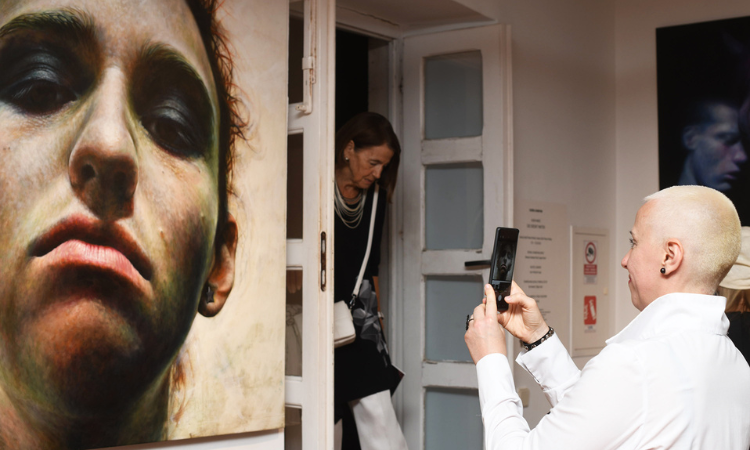
The Dulčić Masle Pulitika Gallery in Dubrovnik has opened a solo exhibition by the prominent Croatian contemporary painter Eugen Varzić, titled “Size Doesn’t Matter”. Curated by Prof. Vinicije Lupis, PhD, this compelling exhibition presents a dynamic range of works, from monumental formats to miniatures, and functions as a mature synthesis of the artist’s earlier phases. It weaves together his key creative cycles: the evocative, tonally enigmatic “Noire”, the self-reflexive cycle “Sve su ti slike ok” (“All Your Paintings Are OK”), and the expressive, mature cycle “Ma de”. Together they give the public a comprehensive view of the layered style and artistic development of an author who places the human being at the very centre of his painterly concern.
Eugen Varzić graduated in painting in 1999 from the Department of Fine Arts at the Faculty of Humanities and Social Sciences in Rijeka. He then continued his training in Madrid under Antonio López García and Eloy Morales, leading figures of Spanish realism who profoundly shaped his idiom.
Over the course of his career he has held more than forty solo and a hundred group exhibitions in Croatia and abroad, establishing himself as an independent and distinctive voice on the contemporary art scene. Beyond painting, this freelance artist based in Istria works successfully in design, illustration and short film, and is actively engaged in teaching and humanitarian work. He perhaps best summed up his creative philosophy in his acclaimed TEDx talk “Art as Breathing”.
His biography, however, is not merely a dry list of exhibitions and professional achievements. It is an authentic testimony to an artist who refuses to capitulate to the cynicism of the modern age, using the brush as a tool to defend the endangered human soul. In an era of pervasive superficiality, digital alienation and the overproduction of ephemeral content, Varzić’s choice to live painting as a daily ritual, almost as a means of survival, reads as a quiet but persistent rebellion.
At its core, his work is a return to the original craft of figuration, to the meticulous depiction of the figure and careful contemplation of raw human emotion. This return to roots is not an escape from the contemporary world. It is, on the contrary, its most direct and profound confrontation. In a world that is increasingly fragmented, alienated and dehumanised, Varzić finds his artistic refuge and moral anchor in a deep humanity: in honestly observing the person who is before our eyes every day, and whom we so often fail to see.
Caught in the rift of global chaos and post-pandemic alienation, corporate capitalism, with money as virtually the sole measure of value, relentlessly reduces us to units of consumption and tramples what is most essential in us. The present moment imposes merciless imperatives, expecting people to be forever young, aesthetically polished, infallible, productive and ruthlessly successful. It is as if we have been stripped of the right to imperfection, to ageing, to sorrow and to vulnerability. Even existence itself is increasingly quantified through algorithms, likes, statistics and cold media records, while information overload slowly desensitises us to the pain of others and to genuine intimacy.
Against a World That Turns People into Numbers
In such a world, Eugen Varzić’s exhibition becomes a space of resistance to false ideals. While the media bombard us daily with the uniform, faceless products of the beauty industry, Varzić does the opposite. He paints real human tissue: weariness in the eyes, creases in the skin, anxiety, transience and pain. His painting lands like a slap in the face of the imposed image of success. By exhibiting faces that bear the scars of life, he offers us not an embellished reality but a truthful one. He seeks beauty not in plastic but in humanity.
His figures are not designed to the standards of advertising, the market or corporate aesthetics. They are great precisely because they have survived their own chaos, both small and large. Their faces need no embellishment, because what life has already left on them is more than enough.
While contemporary society accustoms us, through screens, to a cold distance, Varzić brings us back to closeness. In his hands the miniature becomes an act of enforced intimacy: a close-up gaze that compels us to pause before a small square of canvas and reawaken what the everyday visual noise has nearly lulled to sleep within us, namely the capacity to feel.
“I have suffered, I have loved, I exist.”
In a world that acknowledges only what is massive, impressive and expensive, the small format acquires an entirely new dimension. It becomes a kind of shield against corporate megalomania. The artist deliberately refuses to play by the rules of spectacle. He needs no giant screen, no gigantic billboard, no grandiose scale as proof of significance. A hundred small paintings arranged in space function as a hundred quiet sanctuaries for the human soul.
Within just a few centimetres, the artist manages to preserve what can be neither bought nor quantified: sentiment, compassion and the right to inner pain. To see these works at all, we are forced to approach them. A few centimetres’ distance from the canvas suddenly becomes a few centimetres’ distance from another human being. This physical act of drawing near thus takes on an almost symbolic value, restoring a closeness we have somehow lost along the way.
Eugen’s works are also an artistic response to a world gone mad, in which people are reduced to administrative categories and lists: “X dead”, “Y infected”, “Z unemployed”. Our senses have grown numb to such cold data. Yet behind every number there is a face, and behind every face there is a life.
Varzić shatters this distance with his profound sensibility. Instead of graphs and tables, he sets before us individual faces immersed in the darkness of chiaroscuro or steeped in the silence of melancholy. Each seems to say: “I am not a number. I have suffered, I have loved, I exist.”
Rejecting superficial spectacle, the artist finds deep meaning in seemingly ordinary, isolated people. He elevates them not because they are exceptional, but because they are human. His art restores weight to what everyday life constantly tries to render insignificant.
The Face as a Space of Inner Life
By painting faces from his own neighbourhood, with close attention to their transience, Varzić restores human dignity. He compels us to look closely at the details of existence that the modern world overlooks too quickly. His figures are not generic faces. They bear traces of anxiety and isolation, but also of pure, raw love. Varzić is not ashamed of emotion; he lays it bare.
Through layers of paint, visible drawn lines and unfinished fragments on the canvas, he shows us that a human being is never a fully finished picture. We are fluid, vulnerable, changeable and transient. That is exactly why his portraits do not read as cold records of someone’s appearance, but as spaces of inner life.
Looking at these faces, which speak with a “cry of truth”, the viewer almost imperceptibly begins to cross over to the other side of the painting. The question is no longer only “Who is the person in the painting?” but the far more uncomfortable and important one: “Can I still recognise a human being in the other?”
His paintings do not stay on the wall. They challenge the viewer not merely to observe the work but to live through it, to suffer alongside it, and to find in it an echo of their own. Between empathy and projection there opens an inner landscape of the experiences we pass through as we look at another person and try to understand them. In that space we are no longer analysing only a canvas, but a human being, and through them, inevitably, ourselves.
Perhaps this is where the deepest strength of Varzić’s painting lies: it does not allow us to regard the other as entirely foreign. In another person’s face he always leaves enough room for us to appear as well.
A Greatness Beyond Measure
In this context, the title’s claim that size doesn’t matter takes on its full meaning. Size truly ceases to matter where we measure it by format, space and physical dimensions. But when it comes to the capacity to understand another person, to accept their vulnerability and make room for them within ourselves, size is no longer a question of measure. It becomes everything.
A great person is not the one who takes up the most space, but the one who knows how to create space for others.
That is exactly what Varzić does. By turning people from everyday life into his models, he opens a lasting place for their faces and destinies in the community’s cultural memory. He gives them the most precious thing art can offer: the right to be seen, remembered and rescued from oblivion.
What Remains When All Else Falls Silent
Painted in this way, they go on living beyond their own time. Their faces remain witnesses to an era, but also a reminder of something no era should ever lose: the knowledge that behind every figure, every category and every statistic there is a unique human being.
And it is precisely in this uniqueness of the human being that a pure, almost sacred thread glimmers: that mysterious and authentic something within us, overlooked every day and yet so worthy of our gaze. It is a true reminder of our own essence, which an artist of genuine sensibility recognises and, through his poetics, makes visible.
It would therefore be invaluable for audiences in Mostar, too, to have the opportunity soon to encounter the work of Eugen Varzić, an exceptionally courageous and provocative artist. His paintings ask of us not only our gaze; they demand closeness. And it is in this physical and emotional approach that their most important message lies hidden: in a world that teaches us distance every day, truly seeing and feeling another person again becomes one of the last refuges of our humanity.
Upit o ovom radu ← Natrag